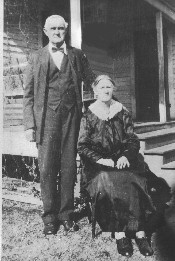
 Luther and Eugenia (Gene) settled into married life after his military
service in early 1919. He was 26 and she was 19. They lived with her parents,
Hawk and Josie Houston, at Old Hickory. By July 1919 they had contracts to teach
at Sunnyside School for the 1919 - 1920 school term, but when they learned that
she was pregnant, they had to get out of the contract. Pregnant women could not
teach back then. People didn't even talk about pregnancy in public and various
euphemisms were used even in private conversation. When this job didn't work
out, Luther got the following contract to teach the 1919 - 1920 term at Old
Hickory where his brother-in-law was on the school board. The pay of $3.00/day
was very good pay for the time.
Luther and Eugenia (Gene) settled into married life after his military
service in early 1919. He was 26 and she was 19. They lived with her parents,
Hawk and Josie Houston, at Old Hickory. By July 1919 they had contracts to teach
at Sunnyside School for the 1919 - 1920 school term, but when they learned that
she was pregnant, they had to get out of the contract. Pregnant women could not
teach back then. People didn't even talk about pregnancy in public and various
euphemisms were used even in private conversation. When this job didn't work
out, Luther got the following contract to teach the 1919 - 1920 term at Old
Hickory where his brother-in-law was on the school board. The pay of $3.00/day
was very good pay for the time. TEACHER'S CONTRACT (State of Arkansas, County of Conway)
This agreement, between Cleve Massingill and John H. Houston, Jr. as Directors of the School District No. 36 in the County of Conway State of Arkansas, and Luther A. Maxwell a teacher who holds a license of the First grade, and who agrees to teach a common school in said District, is as follows:
The said Directors agree, upon their part, in consideration of the covenants of said teacher, hereinafter contained, to employ the said Luther A. Maxwell to teach a common school in said District the term of Four (4) months, commencing on the 24th day of November A. D. 1919 to pay therefor [.] manner, and out of the funds [.], the sum of Ninety ($90 00/xx) [.] each school month.
The remainder was too chewed up to read but it said that the school would be kept open six hours a day and a register would be maintained as required by law. The teacher would preserve from injury to the utmost of his power (the students); give said school his entire time and best efforts . . . his utmost influence with parents to secure full attendance . . .
Luther filled out the form in his distinctive penmanship. It was signed by John H. Houston and G. C. Massingill. Luther signed as teacher. It appears to have been dated the first day of school. The "Place" (of the signing) was not identified.
Luther and Gene's first child, my mother, Eva Louise Maxwell, was born February 17, 1920. They were probably still living with Gene's parents because Louise was born there in Old Hickory. Luther was 27 and Gene was 20. His parents, Alvus and Mary Ann, were 49 and 51 and her parents, Hawk and Josie, were 60 and 58. My mother used only her middle name and until her dying day my sister and I thought that her first name was pronounced with a long 'E' as in 'even' but the younger children said it was pronounced as the 'e' in 'ever' the same as Eugenia's sister, Eva, pronounced her name.
Luther taught the 1920 summer term at Round Mountain three years after my Grandfather Skipper and his family had moved from Round Mountain to England, Arkansas. Ira Skipper, one of my Grandfather Skipper's cousins, taught the Round Mountain school in the mid-teens.
Luther was back at Old Hickory for the 1920 - 1921 school term. He probably taught the 1921 - 1922 and the 1922 - 1923 terms at Hattieville where Paul Turner, one of my father's cousins, was one of his pupils.
Luther bought property near his parent's farm on the top of Bull Mountain and built the family home at its present location around 1922. He was 30 years old.
THE HOUSE
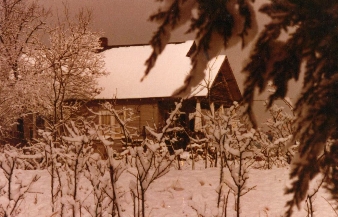 The Architecture
The house was a square, wood frame house with 104 style wood siding and a wood shingle roof with a 45 degree pitch. The porch had a gable roof that was integral with the house roof. I remember that Grandpa told me the house was made of cyprus. The exterior siding certainly has withstood the vicissitudes of time very well. The house is supported on columns of flat rocks laid without morter. The northwest corner was only on rock high, but the southeast was about eight rocks high.
The Interior
The house was divided in quarters to produce roughly equal square rooms. The living room was in the southeast corner; the kitchen in the southwest. The northeast and northwest rooms were the bedrooms. The interior walls and ceilings (except the front bedroom ceiling) were of rough 1x12 boards. The floors were smooth tongue and groove lumber. The ceiling of the front bedroom was beaded tongue and grove finished lumber. Baseboards and door and window frames were cut from plain lumber.
A chimney was at the center of the house where the walls joined. There was a flue opening into the interior corner of each room near the ceiling, but only the kitchen and living room flues were used. There were no closets or built-in cabinets. Each room had an exterior door for ventilation or quick access to the outdoors at night. The two front doors opened onto the porch. There were four interior doors; one in each of the four interior walls. The living room interior doors were located near the exterior walls; the back bedroom doors were in the center of the walls. There were windows in the exterior walls of each room. The living room had a double window on the south wall.
Furnishings
A wood cook stove was used for cooking and a freestanding wood heat stove in the living room provided additional heat. The stoves were connected to the flues with stovepipe.
In the kitchen, in addition to the stove, there was freestanding cabinet that had a work surface, a pull-out dough rolling board, two large pull-out bins for corn meal and flour, and a three-door shelf unit for general storage. The Old Farmer's Almanac hung from a hook on the side of the cabinet. They eventually got an icebox for storing milk and butter and other food items that needed to be kept cool. Dishpans were placed on tables for washing dishes. Water was heated on the stove. Dirty water was dumped out the back door.
Water from the 'drilled' well had some kind of iron compound in it that caused a funny taste and stained everything with a rusty red stain. A pole framework supported the pulley for the well chain. The water level was about 20 feet below ground level so a lot of chain pulling was required to get a bucket of water out of the well. A nail in one of the frame posts held the loops of chain as it was pulled out of the well.
They sometimes collected rainwater for washing clothes and hair.They usually washed clothes in a black washpot of water heated over a wood fire in the yard. Flakes of homemade lye soap were chipped into the hot water. They kept an ash barrel for making the lye for the soap. A stick was used to adgitate the clothes. The wet soapy clothes were then rubbed over the ribs of a rub-board to work the dirt out.
There was no bathroom and they didn't even have an outhouse. Luther simply went outdoors or to the barn and Gene and Louise used a 'slop-jar' (or pot) that Luther dumped out behind the smokehouse. I don't know why they didn't have a commode stand with a nice contoured seat to hold the slop-jar with a lid to cover it when not in use. At least I don't remember one when I lived there in the 1940s. Toilet tissue was a luxury and they probably used something else most of the time. Louise said that she used twigs for toothbrushes. She chewed the end into fibers and then brushed her teeth. 'Sponge bathing' probably supplemented the traditional Saturday night bath in a tub on the kitchen floor.
Luther used a 'straight' razor for shaving most of his life even though 'safety razors' became available about the time he started shaving. He had a leather strop to sharpen the razor. The strop, or strap, consisted of two strips of leather, one smooth and one coarse, about 3" wide by 24" long held together by a metal fitting at one end. A metal loop connected to the fitting allowed it to be hung on a hook. Strops were usually handy for applying corporeal punishment to misbehaving children.
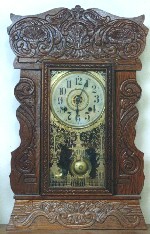 A mantel clock sat on a little shelf on the south wall
of the living room near the southwest corner of the room. The clock is still
running eighty years later. The striking spring has been replaced and some
bushings were 'retrofitted' at a cost of about 30 times the clock's original
purchase price.
A mantel clock sat on a little shelf on the south wall
of the living room near the southwest corner of the room. The clock is still
running eighty years later. The striking spring has been replaced and some
bushings were 'retrofitted' at a cost of about 30 times the clock's original
purchase price. There were one or two wood rocking chairs and a couch that folded out to make a bed. The arms and back of the couch were made of wood with sharp edges and the seat and back cushions were very firm and had a slick finished 'leather look' canvas type covering.
The walls and ceiling of the rooms were covered with wallpaper with decorative paper borders and the floors were covered with linoleum rugs. The wood of the exposed floor between the rug and the walls was varnished a dark brown color.
Kerosene lamps were used for light. They even had two of the modern Aladdin Lamps that had ceramic mesh mantles that created a brilliant light in the flame of the burning kerosene wick.
There were beds with metal frames in the bedrooms. There was a homemade quilt press in the back bedroom. A shelf unit had been built against the south wall of the back bedroom between the door to the kitchen and the exterior wall. The shelves also served as a ladder for access to the attic.
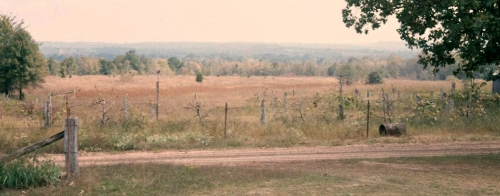
THE LAY OF THE LAND
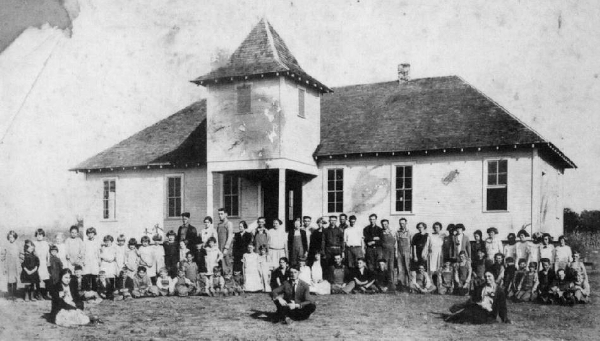
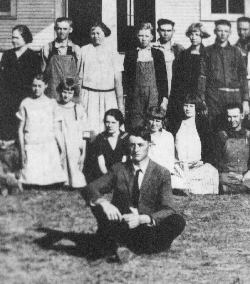 Luther taught the 1923 - 1924 school term at Lanty. This school photo
was taken November 14, 1923. The schoolhouse was not far from the location of
the little log cabin the family had lived in when Luther was born 31 years
earlier. It is obvious from the close shot of the school photo that Luther had
aged. In those days the teacher was allowed to be a member of the basketball
team. Luther and his Lanty team played Howard Bradford and his Cleveland team
one time. Luther didn't like the way Howard and his team played so he wrote a
letter to Howard with his complaint. Howard wrote a scathing reply which Luther
kept for many years. Howard became a prominent citizen of Cleveland. His wife
Sybil directed the Vacation Bible School when I was a child. They were customers
on my Grit route. Howard died a few years ago at the age of 101. I
visited him in a rest home right after his 100th birthday.
Luther taught the 1923 - 1924 school term at Lanty. This school photo
was taken November 14, 1923. The schoolhouse was not far from the location of
the little log cabin the family had lived in when Luther was born 31 years
earlier. It is obvious from the close shot of the school photo that Luther had
aged. In those days the teacher was allowed to be a member of the basketball
team. Luther and his Lanty team played Howard Bradford and his Cleveland team
one time. Luther didn't like the way Howard and his team played so he wrote a
letter to Howard with his complaint. Howard wrote a scathing reply which Luther
kept for many years. Howard became a prominent citizen of Cleveland. His wife
Sybil directed the Vacation Bible School when I was a child. They were customers
on my Grit route. Howard died a few years ago at the age of 101. I
visited him in a rest home right after his 100th birthday. 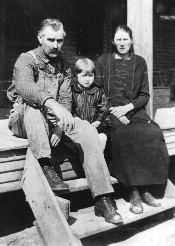 Luther's father, Alvus, died of an apparent heart attack on a trip to Morrilton on May
8, 1929. He had asked Luther to go with him, but Luther didn't want to. Of
course, he regretted that decision after his father died. This photograph of
Alvus and Mary Ann with their granddaughter Louise was made about 1926 when
Louise was six, Alvus was 56 and Mary Ann was 57.
Luther's father, Alvus, died of an apparent heart attack on a trip to Morrilton on May
8, 1929. He had asked Luther to go with him, but Luther didn't want to. Of
course, he regretted that decision after his father died. This photograph of
Alvus and Mary Ann with their granddaughter Louise was made about 1926 when
Louise was six, Alvus was 56 and Mary Ann was 57. 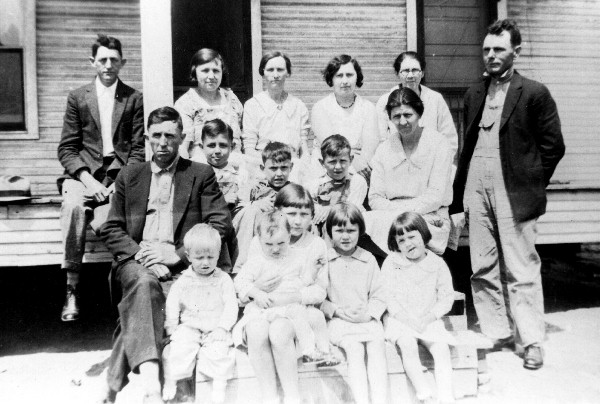
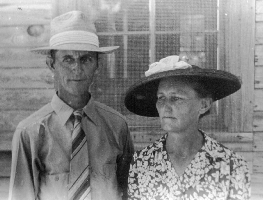 The family settled down in the house on the farm. The house was ten
years old. Momma said that Grandpa never repainted it.
The family settled down in the house on the farm. The house was ten
years old. Momma said that Grandpa never repainted it. 