MAXWELL
|
PHOTO CREDIT: F. Dundas Todd � 1893 |
 |
|
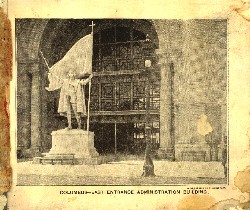
This
is a view of the statue of Columbus at the entrance to the Administration
Building at the World's Columbian Exposition from a 6 1/2" x 5" souvenir
photo booklet. The booklet contains 90 pages with images front and back
for a total of 180 photos from the Columbian Exposition. The front and
back covers of the booklet are missing. |
Luther Alonzo Maxwell was born in 1892, the 400th anniversary of the arrival
of Columbus in the West Indies. Preparations for the World's Colombian
Exposition were being made in Chicago. The United States and the world were on
the threshold of a new age of electricity and gasoline - an age of unprecedented
personal transportation. Electricity had already
revolutionized communications through the telegraph and telephone and steam had
revolutionized transportation. But even after 100 years, flight in
lighter-than-air craft was still a rare thing. The power of gasoline would soon
make flight relatively common. Steam was also providing power for farm and
industrial processes that made possible efficiencies that had never been known
before. More electricity was used for the Colombian exposition in 1893 than in
all the rest of Chicago combined. However, electricity did not become available
at Luther's home for 55 more years and he never really took advantage of the
personal power of gasoline although he once owned a T-Model. He never flew in an
airplane. He did eventually get to enjoy some of the simple things introduced at
the Fair such as Juicy Fruit gum. Apparently carbonated sodas and hamburgers
were presented to a mass market for the first time at the Exposition food booths
although there is some dispute over the time and place that hamburgers, as we know them, originated.
Another new
thing was introduced to American society at that time. The
Pledge of Allegiance to the Flag was written the month Luther was born
and was published in The Youth's Companion magazine. It was written by an
American Baptist minister for use in commemorating the first official Columbus
Day. On Columbus Day 1892 it was recited by millions of public school students:
"I pledge allegiance to my Flag and to the Republic for which it stands, one
nation, indivisable, with liberty and justice for all."
When Luther was
about 30, words were added to identify the "Flag" as "the flag of the United
States" and the words "of America" were added a few months later.
When
Luther was about 62, the phrase "under God" was added to distinguish us from the
"Godless" communists! The law making "under God" part of the pledge of
allegiance was signed by President Dwight D. Eisenhower. The special order
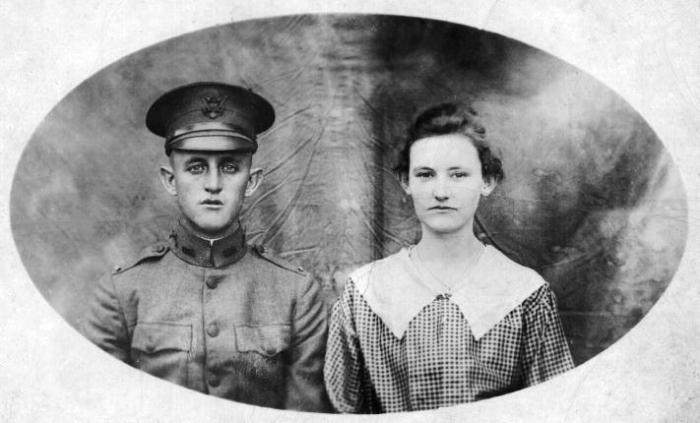
relieving 2nd Lt. Luther Maxwell and his fellow officers from duty in 1918 was
signed by Lt. Col. Dwight D. Eisenhower.
Alvus and Mary Ann Maxwell
lived in a little log cabin in Lanty, Arkansas, when Luther was born on August
22, 1892. Mary Ann went to her mother, Belfame's, nearby home for the birth.
Alvus and Mary Ann already had a son, Marvin, who was a year and two months old.
The Maxwells eventually moved about two miles west of Lanty to a
location a mile or two north of Bull Mountain a little way from what is now
State Highway 95. They lived near the old McElroy school house which was about a
half mile from the highway. The school building was moved to a site on the
highway and is now used as a church meeting place. A cemetery is directly across
the highway from the building.
Luther's brother, Noah, was born in 1894
probably at that location. Then Lucinda Bell, named for her grandmothers, was
born in 1896, but died the following year. Luther was only 3 � years old when
Lucinda Bell was born and 5 when she died but remembered her well and referred
to her occasionally in later life. 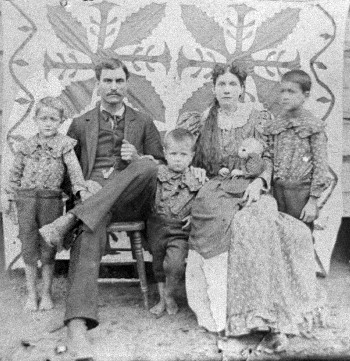 This family portrait was made just a short time after Dove was born on
February 17, 1898. Mary Ann had just turned 29 and Alvus was 28. Marvin,
standing by his mother, was 7. Luther, standing by his father, was 6. Noah was
4. The location for this photograph is not clear. No one remembers whether Dove
was born before or after they moved to the top of Bull Mountain. The siding
visible at the edges of this photograph doesn't seem to match the siding of the
house on the hill, but it isn't really clear. The photograph was probably taken
at their home wherever it was.
This family portrait was made just a short time after Dove was born on
February 17, 1898. Mary Ann had just turned 29 and Alvus was 28. Marvin,
standing by his mother, was 7. Luther, standing by his father, was 6. Noah was
4. The location for this photograph is not clear. No one remembers whether Dove
was born before or after they moved to the top of Bull Mountain. The siding
visible at the edges of this photograph doesn't seem to match the siding of the
house on the hill, but it isn't really clear. The photograph was probably taken
at their home wherever it was.
Luther probably started school in the
fall of 1898. I think that he had been anxious to start school, because he once
told me that the start of school was delayed at the request of the parents until
the crops could be brought in. That sounds like something someone who was
anxious to get started to school would have remembered.
Meanwhile in Old
Hickory, about eight miles from the Maxwells, Luther's future bride, Eugenia
Francis Houston, was born May 21, 1899, to John Hawkins Houston (6-22-59/6-2-36)
and Josie (10-23-61/6-3-33). Hawk was 40 and Josie was 38. Luther was almost
seven, but it is unlikely that the Maxwells knew the Houstons.
On June
1st, eleven days after Eugenia was born to the Houstons, Luther's little
brother, Virgil, was born to Alvus and Mary Ann.
While I'm thinking of
family stories, I'll add two that Grandma Maxwell always told. Her Houston
ancestors came to America before the Civil war, but I don't now how long before.
The family consisted of a man and wife and several children. Yellow fever broke
out on the ship and the parents asked the Captain to promise to see that the
children were settled somewhere together if anything happened to the parents.
Unfortunately both the parents and the Captain died of the fever before reaching
shore and the children were scattered. The members of the branch of the family
from which she descended didn't know what happened to the others. Grandma was
also told that the family women hid the men under leaves in a ditch when the
soldiers came to get them during the Civil War. I don't remember whether they
were to be drafted or whether the soldiers were the enemy coming to capture
them. I haven't asked anyone to confirm these stories until recently and so far
I haven't found anyone else who remembers them.
Lanty is about 10 miles
north of Morrilton, the county seat of Conway County. Although travel along the
dirt country roads was difficult, Luther probably got to go to 'town' when he
was a little boy. Imagine how exited and amazed he must have been the first time
he saw a train pull into the Morrilton station. With an engine that looked as
big as a small house and running on its own power at speeds faster that any
horse could run, the train must have seemed to be the epitome of modern
civilization. The railroad had been providing transportation of goods and
passengers for Morrilton for about twenty years when Luther was a boy, but the
budding petroleum and auto industries were set to revolutionize transportation
and the world economy. However, the effects of that revolution were not to be
seen for another twenty years.
Luther turned eight years old during the
last year of the century. The family had probably moved to the old home place by
1900. During that year Alvus turned 30, Mary Ann was 31 and would have her 32nd
birthday at the end of the year. Marvin was nine, Luther was eight, Noah was
six, Dove was two, and Virgil was one. Luther's grandmother Belfame Harrington
was a 60-year old widow living in Lanty with a son about Luther's age. His
Maxwell grandparents, Jack and Lucinda, were 58 and 54 respectively and lived in
Carroll County in north Arkansas.
In those days New Years Day was
celebrated by blowing up anvils, firing guns into the air, ringing church bells,
and noise making in general. Grandpa was old enough to remember that the end of
the century was celebrated with a little more enthusiasm than the usual New
Year. 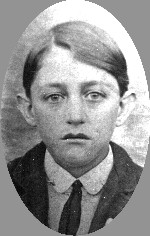 Sister Kate was born February 24, 1901, the first year of the new century. She
was the final child of Alvus and Mary Ann. This portrait of Luther may have been
taken near his ninth birthday on August 22, 1901. He should have started the
third grade that fall.
Sister Kate was born February 24, 1901, the first year of the new century. She
was the final child of Alvus and Mary Ann. This portrait of Luther may have been
taken near his ninth birthday on August 22, 1901. He should have started the
third grade that fall.
Toys were simple in those days. Most boys
probably had a rubber ball, a top, and some marbles. Homemade toys were fun
also. Buttons and loops of string provided a lot of entertainment. By looping
string around the fingers and manipulating the fingers in a specified sequence,
intricate spiderweb-like patterns could be created much to the amazement of
friends who didn't know how. It was also fun to loop a string through the holes
of a large button and make the button spin by pulling the ends of the loops,
which were looped over the index fingers. The string would windup and then
unwind as the pressure on the string was increased and relaxed. A strong string
would last many cycles before wearing out from all the friction. I think they
used sling shots some, but rubber strips may not have been readily available for
'bean flips.' I also think that bicycles were too expensive for country folks.
The condition of roads and trails probably limited the utility of bicycles in
the country anyway.
The Wright brothers made their historic flight in
1903 after Luther turned 11. As I recall, he gave me the impression that by the
time he saw an airplane, he was so well informed about them that it was not a
really exciting thing.
Another society-changing event of 1903 was the
introduction of the 'story' movie, The Great Train Robbery. Systems for photographing and
viewing 'moving pictures' had been developed in France and the United States at
the end of the 19th century, but this short movie attracted the attention of the
public and society was changed in ways we are still trying to understand.
 By
his 12th birthday on August 22, 1904, Luther probably had completed the 6th
grade. Schools were so irregular back then that it is hard to say whether that
would be equivalent to six full years of school today. The subjects certainly
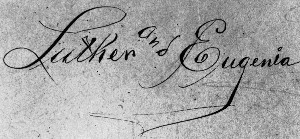
were different. For example, penmanship was an important skill at that time and
the copy of Luther's penmanship at the beginning of this article illustrates the
flourishes that they were taught in school. There were no ballpoint pens back
then and fountain pens had only been in production for about twenty
years. Steel 'nibs' to insert into the pen handles had been in use for a century
and were readily available to most people. The nibs had nice tips shaped to help
create the flourishes. Calligraphy would be the current manifestation of that
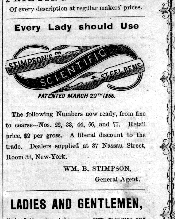
art. The ad for Stimpson's SCIENTIFIC Steel Pens shown at left is from
DEMOREST'S MONTHLY MAGAZINE, Vol. 3, for January 1867. The pens were
patented March 20th, 1866. The price was $2/gross (144) with a liberal discount
to the trade.
By
his 12th birthday on August 22, 1904, Luther probably had completed the 6th
grade. Schools were so irregular back then that it is hard to say whether that
would be equivalent to six full years of school today. The subjects certainly
were different. For example, penmanship was an important skill at that time and
the copy of Luther's penmanship at the beginning of this article illustrates the
flourishes that they were taught in school. There were no ballpoint pens back
then and fountain pens had only been in production for about twenty
years. Steel 'nibs' to insert into the pen handles had been in use for a century
and were readily available to most people. The nibs had nice tips shaped to help
create the flourishes. Calligraphy would be the current manifestation of that
art. The ad for Stimpson's SCIENTIFIC Steel Pens shown at left is from
DEMOREST'S MONTHLY MAGAZINE, Vol. 3, for January 1867. The pens were
patented March 20th, 1866. The price was $2/gross (144) with a liberal discount
to the trade.

|
CHILDHOOD 1892-1904 |
YOUTH 1905-1910 |
EARLY
TEACHING CAREER 1910-1917 |
MILITARY
and MARRIAGE 1917-1918 | Family
and Final Teaching Career 1919-1932 |
|---|
| SITE INDEX Originally posted in 2002. Moved to this host 2026 |