HALBROOK STORIES
Incident in Which One of Andrew’s Nephews Was Killed
This story took place in 1922. Even now, 80 years later there may still be
some hard feelings so the names of the participants have been changed. The
participants were a pregnant young wife; a teacher named Bill; Bill’s big
brother, ‘Tiny’; and, of course, Andrew’s nephew. The incident happened at Henry
Frazier’s mercantile store. The young wife’s sister was my Sunday School teacher
when I was a little boy. The teacher’s widow was one of my high school teachers.
Henry Frazier married my mother’s Aunt Kate a few years later.
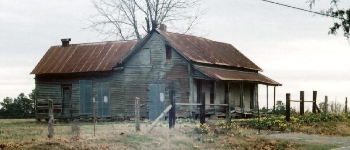 The teacher lived on the west side of the road
across from where the young wife lived. He taught in a school that was east of
where they lived so he passed by the young wife’s house on his way to and from
school. This photo shows the young wife’s house as it stands today - 80 years
after the incident. The fireplace has been removed and the well cover is gone,
but the jonquils are still blooming in the front yard.
The teacher lived on the west side of the road
across from where the young wife lived. He taught in a school that was east of
where they lived so he passed by the young wife’s house on his way to and from
school. This photo shows the young wife’s house as it stands today - 80 years
after the incident. The fireplace has been removed and the well cover is gone,
but the jonquils are still blooming in the front yard.
One day the young
wife was out at the well when the teacher walked by on his way home from school.
He apparently stopped to talk, because she later told that he had propositioned
her. The storyteller didn’t tell whether the teacher disputed the charge. It was
a scandalous thing in the community especially since she was about eight months
pregnant.
Men of the town took sides on the issue and the fact that some
men were moonshiners and other men were opposed to whiskey may have entered into
the argument. Several men, including Bill, Tiny, and Andrew’s nephew had
gathered in the road in front of Henry Frazier’s general store in Cleveland and
the argument about this issue became so heated that some of the men decided that
they should disarm Tiny and Andrew's nephew. They took the rifle away from
Andrew’s nephew, but Tiny managed to keep his. The men continued the argument
inside Frazier’s store and Andrew’s nephew pulled a pistol and shot Bill in the
hand. Andrew’s nephew then ran out the back door of the store and toward a
relative’s house where he could retrieve his rifle. However, when the cry rang
out "Bill’s been shot!" Tiny didn’t wait to see how badly Bill was hurt. He ran
to the door and shot Andrew’s nephew in the back.
Tiny was convicted and
sentenced to three years in prison. A fraternal organization helped obtain his
release after a short time. The families involved were very upset with each
other for many years.
Thirty-five years later when my mother married
Lyonell Halbrook and we moved to Cleveland, Henry Frazier still had a store and
he and Aunt Kate lived beside the road to the school. I enjoyed stopping to
visit her on the way home from school and it was a special treat to stop at his
store for candy.
A TRUE STORY OF LOVE AND BETRAYAL
IN EARLY TWENTIETH CENTURY RURAL
ARKANSAS
The story spans most of the twentieth century, but begins in 1925 with the
marriage of Stella, a beautiful, twenty-year-old woman. Stella and her husband
soon had a baby boy, but not long after the baby was born, Stella came home to
find her husband in bed with her sister. Naturally this created a big scandal in
the family. Stella’s mother-in-law advised staying with the marriage. Perhaps
she felt that Stella and her sister were as much at fault as her son was.
Stella’s father-in-law told her to make her own decision and not listen to the
family. Stella decided on a divorce and her husband and sister left the country
to escape the censure of the community.
At that same time, an oil well
was being drilled in the community. Two local men had been to the Oklahoma oil
fields and had returned with a drilling rig and a plan to sell shares in an oil
well venture. They brought a rich oilman with them and he courted and married
Stella. When it became obvious that no oil would be found, the investors raised
a ruckus and the oilmen went back to Oklahoma. When Stella and her little boy
got to Oklahoma with her rich oil man, she found out that he already had a wife
and family and wasn’t rich enough to support two. She immediately returned home
to Arkansas.
By 1930, at the age of 25, Stella had been betrayed in two
marriages and was back home caring for a five-year-old son. There in the same
country was a man of 50 named Bill, who was at the height of his career in the
field of secondary education. He had received an excellent education for that
time and in 1906 had married Mary, a sweet young woman he had met in college.
She taught school with him until the birth of their first child in 1913. She
stopped teaching to care for their son and they soon had three more children.
However, by about 1920 problems came to their happy home. First a daughter’s eye
was shot out by a little boy with a neighbor’s 22 rifle. Then Bill’s wife began
to have spells and also had to have surgery for cancer. She was better for
awhile, but the spells eventually returned. One day she came to Bill and said
that something would have to be done with her. She had found herself with a
butcher knife in her hand and an almost uncontrollable urge to kill the
children. She was eventually committed to the State Hospital for the Mentally
Ill. During this time Bill was out of work for several months as he recovered
from several surgical operations. Then in 1933 his position in the school system
was eliminated by a "re-actionary governor and legislature . . . [that]
wreck[ed] the public school system." as he said in his 1959 autobiography. Bill
was able to get work doing research for the Works Progress Administration which
helped tide him over.
Eventually Bill’s health and job situation
improved and his wife was released from the hospital. They returned to the
mountain country that they loved well and settled down to care for his invalid
mother. Not long after they had returned, Mary was diagnosed with lung cancer
and she died soon afterward.
The year was about 1945 and Bill was a
widower of 65, retired and doing substitute teaching in the local high school.
He also helped his two brothers in caring for their mother. Stella was now 40
years old and was trying to make a little extra money working as a cook in the
high school cafeteria. Bill met her there and found out that she, too, was
caring for elderly family members. As Bill wrote in his autobiography, his
"second matrimonial venture was partly romantic and partly a matter of
necessity." Stella was a ‘widow’ with no income except what she could make
helping neighbors and as the cafeteria cook. Bill and his brothers needed help
with their blind mother, who was over 90 years old.
So Stella at 40 and
Bill at 66 got married and lived happily ever after. Actually they didn’t live
forever after; Bill died in 1975 at the ripe old age of 96 after 30 years of
marriage to Stella. Stella lived another 26 years and died in 2001 also at the
age of 96.
Andrew Makes a Little Profit on the Oil Well
In 1922 a couple of men returned to the community after a time in the oil
fields of Oklahoma and began to sell shares in an oil well venture. They had the
drilling equipment shipped in to Morrilton by rail and were paying $20.00 per
load for local truckers to haul the parts out to the well site. Andrew was
acquainted with the men and they asked him to haul a load. One of the men jumped
into the cab with Andrew to get a ride out to the site. On the way, the man
said, "Andrew, there’s enough money in this country to drill that well even if
it comes up dry." When they got the equipment unloaded, the man asked Andrew
whether he wanted his pay in shares or cash. Andrew said he needed the cash now,
but that he might consider shares later. He had made up his mind not to invest
in the well when the man said what he did on the way. Andrew was the only man to
make any profit from the well. The other truckers had accepted shares as their
pay and the well turned out to be dry.
All the investors lost their
money. A group of black investors went to the well site to get an accounting of
their investment, but the oilmen shot one of the black men in the legs. The
oilmen panicked and headed back toward town, but got stuck in one of the worst
mud holes in the highway. The black folks found them there drunk and asleep in
their vehicle but managed to get around them and go on their way with their
wounded friend. That ended the oil well business in that part of the country.
STORIES ABOUT ARNOLD
Arnold Walls married Rose around 1925 and became the first family in-law.
Arnold must have been a strong young man and a willing worker. He was a good
hand to help with the Halbrooks' crops.
Arnold Tries to Ride 'Big Jim'
Arnold had been plowing all day with
‘Big Jim,’ the mule that Andrew had bought from his brother, Jim. Big Jim was
good for plowing, but not for riding. At the end of the day, Arnold was tired
and wanted to ride to the house. He thought maybe Big Jim was tired out too and
since the road was muddy, maybe Jim couldn’t get away from him. After Arnold and
Andrew got the harness loose and had Big Jim out in the muddy road, Arnold said,
"I believe I can ride him to the house if you'll get a twist on his nose and
hold him while I get on."
Andrew put a loop of rope around Big Jim’s nose
and tightened it with a stick.
Arnold started to get on Big Jim and Andrew
said, "Hurry, Arnold, the twist is about to come off!" And when the twist came
off, Arnold came off!
Arnold’s All-Night Ride
Andrew was building houses in the county
seat 20 miles from home and sent word that he needed more lumber. It was in the
afternoon and Arnold was out in the field plowing when the word came. He hooked
up a team to the wagon and went to the sawmill just south of town to pick up the
lumber. Rose had fixed him a sack supper and he headed on to the county seat
before dark. He probably got to the county seat by midnight. Perhaps there was
another wagon ready for his return trip or they may have quickly unloaded the
wagon he drove in. Arnold was a good horse man and his team was in good shape,
so after some feed and water they were ready for the return trip. The horses
knew the way home, so Arnold was able to nap along the way.
By morning he
was back home and out in the field plowing.
Andrew had the record of being
the first man to make the round-trip to the county seat in one day. He started
early and got home late. It would have taken about 14 hours travel time and a
little time for business.
Arnold Shows His Dad How to Pull a Log
Arnold had a good team and
had experience pulling logs. He was over at his father, George Walls,’ place and
his father was trying to pull a big log out of the woods. George had his team
lined up for a straight pull and they couldn’t budge the tree. Arnold told his
Dad, "If you’ll take your team loose, I’ll pull it out for you." George was
insulted that his son thought that he could do a better job pulling logs, but
took his team loose to let him prove it.
George said that, as soon as he saw
how Arnold had hooked up the team, he knew he was going to be able to pull the
log and that made George even madder than ever!
Arnold knew to hook up a
team for a pull at a slight angle; the log would make a slight roll to the side
and once it started moving, the team could keep up the momentum and pull it on
out.
Not much manual labor is required in logging nowadays. They don’t
even saw down the trees. A big hydraulically powered scissors snips the trunks
off at the ground. A hydraulically operated arm is used to maneuver the downed
trees. The trees are then put through a stripping machine and the limbs are
stripped off. The arm then loads the trunks onto a truck. We saw about a dozen
trucks go by the other day while we were back home in Arkansas for a visit. Each
truck was loaded with 15 to 20 logs about 20 to 30 feet long. They were headed
to the paper mill. Save a tree; don’t print this page! Just joking! Print it if
you want to.
Arnold eventual bought a truck and quit farming. He then
bought another and had a trucking business going. He and Rose had two children
and then Rose died of cancer. Arnold remarried and became the police chief at
Morrilton, county seat of Conway County. He maintained a close relationship with
the Halbrooks so that his children would have the heritage of their mother’s
ancestors.
Andrew and Hettie's Baby Girls
Andrew and Hettie moved on into the north edge of Cleveland in a house just
north of the gin and west of the school. Hettie’s brother, Elbert, died there
and her daughter, Reva Dale, was born there in 1924. The land in front of the
gin was a swamp and State Highway 95 was not an improved road. Andrew kept a
team ready to pull folks out when they got stuck in the road.
After a few
years they moved a couple of miles west of Cleveland to a place on the south
side of what is now called Copelin Cave Road. They then moved back to the west
edge of town and lived in a house on the little hill on the south side of
Copelin Cave Road not far from where the Methodist Church building is now
located. They were building a nice new house on the north side of the road and
it was completed in time for Hettie Mae to be born there in 1929.
When
the time for Hettie Mae’s birth had come, they sent Clyde to take 5-year old
Reva Dale to stay at Rose’s. After the baby was born, Clyde went back and
brought Reva Dale home. He told her that the doctor had brought her a new baby
sister. She had a hissy fit and insisted that they tell the doctor to take the
baby back. Hettie had the 'milk leg’ after Hettie Mae was born and was confined
to the bed for several weeks. Doc Coley came to check on her every day and Reva
Dale had such a fit whenever he was there that they had to have Rose come to
control her when the doctor made his visit.
An Outhouse Too Far
(skip this one if you are easily offended)
People didn’t have indoor
plumbing back in those days and there are many jokes about outhouses. This one
is supposed to be true. Andrew’s mother didn’t have indoor plumbing, of course,
and their outhouse was way out in the field. It was hard to get the children to
go out that far to use it. There was an ash hopper at the back of the house
where it could collect the rain runoff from the roof and the corner it formed
with the side of the house made a good private place for the little children to
‘be excused.’ The adults kept getting onto them because of the smell so near the
house. One day Jim, one of Andrew’s brothers, was visiting at their mother's
and, sure enough, someone found a fresh pile behind the ash hopper. The adults
questioned the kids and the kids blamed Irene, Jim’s favorite daughter. He said,
"Well, that’s all right. Her ___ don’t stink." Could he have originated that
phrase? Did he just use a phrase he had heard before as a bit of humor to ease
the embarrassing situation? Or did later storytellers create the entire story to
explain why that expression ("She's so beautiful, her ___ don't stink.") was
applied to Irene throughout her youth? Irene died in February 2002 at the age of
89.
Funeral Arrangements
Funeral homes were getting started in Conway County during the 1920s. Frank
Reid helped get his undertaking business going by selling burial insurance
policies. He had agents out in the country selling policies to farmers. Hettie’s
brother, Jim Rhodes, bartered 10 gallons of cane syrup for a family burial
policy and paid one gallon down. Not long after that, his teenaged daughter,
Mamie, pinched a pimple on her face and got an infection. The infection got so
bad that she was taken to the hospital and she died. (And thus we children were
always warned not to pinch pimples.)
The Reid Funeral Home honored the
burial policy even though only one gallon of syrup had been paid. Mamie’s
funeral was one of the first ones way out in the north end of the county to be done by
a funeral parlor and Mr. Reid himself was probably there to see that it was done in
style. Those who attended the funeral were so impressed by the funeral
arrangements that Mr. Reid could hardly get the grave filled for writing new
burial insurance policies!
Before funeral homes started handling
burials, family and friends took care of the dead. The blacksmith shop
in Cleveland kept a supply of wood and hardware for caskets and the stores
stocked coarse cloth to cover the wood. Hettie’s son, Lyonell, remembers how
pretty the white-headed carpet tacks looked on the caskets where they had been
placed along the edges to hold the cloth in place. Family members and friends
dug the graves. Sometimes thin leather ‘lines’ from the wagon harnesses would be
used to lower the casket into the grave because they were thin enough to be
easily pulled from underneath the casket.
I have a receipt that shows
that my Great-grandmother Skipper was buried by an upholstery shop from the
county seat for $37. My Grandfather Maxwell wanted to be buried in one of the
old cloth covered wood caskets the way his parents were. He had a burial policy
with a ‘gold’ certificate at the bottom for a $100 funeral. Lyonell was the
son-in-law then and he believed in burial policies. (Jim Rhodes was his maternal
uncle you see). Lyonell found out that he could buy a policy for my mother’s
parents without telling them about it so he did. He knew that the $100
certificate would no longer be adequate.
When my grandmother died,
Grandpa and Momma went to the funeral home to make the final arrangements and he
insisted that they get the old fashioned wood casket with his policy. Momma
convinced him that there weren’t any old caskets anymore and that $100 wasn’t
adequate for a funeral. Finally she told him that there was another policy to
cover the expense. He was a little upset that it had been done without his
consent, but finally agreed that they had to get Grandma buried. But he took the
policy and said, "Well, I can pay for my own funeral!" and he took the policy
and arranged to start making the payments himself.
Re-posted: 11/12/02
and again in July 2026