HALBROOK STORIES
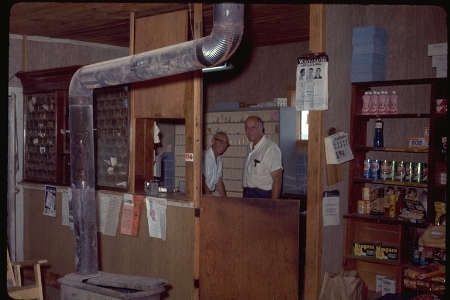
After World War II, my mother married Lyonell Lee Halbrook, who was born and raised in Cleveland, Arkansas, in the north end of Conway County. He probably remembere everything that has happened in Conway County in the first half of the 20th century. When I told him that I planned to introduce the stories this way, he said that he would have to have something to 'jog' his memory to be able to remember everthing! Then he started telling more stories. Some of the stories are about family events, some about interesting things that happened in the community, and a few seem to be 'urban legends'. The Halbrooks would help anyone in need and this first story illustrates that:
I was interested in the availability of ice early in the 1900's and asked if there was a regular delivery of ice out as far as Cleveland (20 miles from the county seat). He said that there was no regular delivery, but that men from the community who drove to town in trucks would sometimes buy a block or two of ice and bring it back to Cleveland. He said that they knew who usually would want ice and they chipped off chunks to re-sell. This reminded him of the baby. A couple named Swain, I believe, had a baby named Clyde, who was dying. He told me what house they lived in for the house is still there. The mother of the baby wanted ice to sooth its final hours and asked a friend (or relative) to bring some back from his trip to town. He expected the baby to be dead before he got back, so he didn't bother with the ice and he probably thought it wouldn't make much difference to the baby anyway. When my step-dad's father, Andrew Jackson Halbrook, heard of it, he hitched up his team and wagon and made the daylong trip to town and brought ice back before the baby died. It didn't keep the baby from dying, but it brought lots of happiness to the family during those final hours.
This story is about my step-dad's mother's grandfather. After the Civil War, ruthless men, some of them civil war veterans, terrorized the South stealing and killing. Eventually any criminals were referred to as bushwhackers. Granpa Rhoades had a young mare and $100 in cash and three men came to his place to take the mare and the money. He refused to reveal the location of either so they led him away and he was never seen again. This story is usually told as we drive past the last place he was seen alive, a wooded ravine leading up into the mountains. Someone who lived there at the time said that they had seen him being lead up the ravine by the three men. Someone in the community, a distant relative or close friend, learned the identities of the bushwhackers, and he went to "call them out" about it and shot them as they came to their doors. I think he only shot two and the third one left the community.
|
|
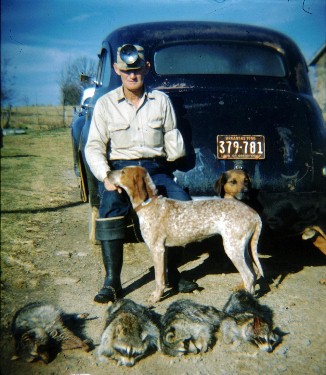
Hi was an avid hunter and fisherman. He is pictured here seated on the back bumper of his old car with his coon dogs at his knees and four fat raccons at his feet. He could roll his on cigarettes. He would put the paper on his elbow stub, open the tobacco pouch with his teeth, pour the tobacco on the paper, close the pouch, and then roll the paper around the tobacco with his right hand. When little boys pestered him with questions about what happened to his arm, he would say, "I'll tell you what happened, if you won't ask any more questions." Of course they would agree and then he'd say, "A horse bit it off!" I still don't know what happened to his arm! This image is from one side of a stereo pair made on Kodachrome roll film. I think it was 626 film. It was made around 1958. I think the licnese plate on the car is for 1955! |
Andrew's brother Allen was much older than Andrew. One
day Allen was hauling a wagonload of cotton to Scotland to have it ginned. As he
passed the gin that was run by the Williams brothers and their father, some of
them came out to see whether he was going to stop and let them gin the cotton.
They got into an argument about it and one of the boys jumped up on the wagon
and started to cut a 'W' on top of Allen's bald head. Allen bled so much from
the first cut that they ended up holding a cloth compress on it and helping him
get on to Scotland.
One of the Williams brothers fell into the gin
blades and the blades ripped several gashes through his ribs. The folks could
see his heart beating through the holes. His brother Jack held him in his arms
and said, "G--- d--- you! Don't die on me here!" But he did.
Daddy could mimic the accents and speech impediments of the people in the community. One older man had a halting speech impediment and Daddy told this story imitating his speech. The man's business was to pick up cattle from farmers in the country and haul them to sell at the cattle sale in town. This was when the larger cities were beginning to use one-way streets for traffic control. The old man was confused and turned the wrong way on a one-way street and was stopped by a policeman who said, "Say, old timer, don't you know you can't drive down the street this way?" The old man replied, "Well, if you'll get out of my way I'll show you I can." I have since heard this story told about other people in other locations, so it may be an early urban legend or it may have actually happened to someone somewhere and was passed on and on throughout the country.
Can you imagine a time when there were no automobiles on the roads, no noisy machinery around the farms, and no mechanically reproduced sound? This story is from that time. There was no TV, no radio, and no phone for keeping up with the news, but you could hear a team and wagon coming from a distance and walk to the road by the time it arrived at your place. Perhaps the traveler would stop for a few minutes to be sociable and exchange news. Andrew McCoy was known as a gruff smart aleck kind of fellow and one day when he hauled a bale of cotton to town, a resident along the road noticed that Andrew had gone by toward town. As Andrew returned from town that afternoon, the resident went out to the road to visit and asked, "Wha'd ya git for cotton?" Andrew didn't stop, but just said, "Goods last spring." (Meaning he had received enough to pay for the purchases he had made in the spring.) The resident said, "You're a smart-aleck, aren't you!" Andrew replied, "I've been told that!" The resident said, "Well, if you'll get out of that wagon I'll beat you up!" Andrew said, "Nah, I turned down a better deal back down the road. A man offered to pull me out of the wagon and beat me up!"
 In the old days, teachers not only disciplined the children, who sometimes were
19 to 20 years old, but also did chores around the school. A teacher had
disciplined a man's older sons and the man was upset about it because he thought
they were too old to be disciplined. He came to school the next morning to "call
out" the teacher. The teacher was splitting fire wood for the school and was
holding an ax. The father said, "If you didn't have that ax, I'd beat you up!"
The teacher slung the ax about 30 feet away and replied, "Now I don't have one."
The father said, "Well, there's no one here to pull me off of you and I'm afraid
I'd kill you, so I'll let you go this time."
In the old days, teachers not only disciplined the children, who sometimes were
19 to 20 years old, but also did chores around the school. A teacher had
disciplined a man's older sons and the man was upset about it because he thought
they were too old to be disciplined. He came to school the next morning to "call
out" the teacher. The teacher was splitting fire wood for the school and was
holding an ax. The father said, "If you didn't have that ax, I'd beat you up!"
The teacher slung the ax about 30 feet away and replied, "Now I don't have one."
The father said, "Well, there's no one here to pull me off of you and I'm afraid
I'd kill you, so I'll let you go this time."
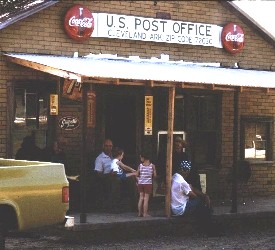
If you have heard similar stories in different settings let me know. The old fellows in our town loved to sit around the stove at the post office or store and exhange stories like this whether they were actual events or not. Here it is summertime and they are sitting on the porch.
John Reynolds Halbrook married a Huie woman and they had William Thomas
Halbrook. She died during a subsequent childbirth and John then married Frances
Driver. John and Francis had nine children: Allen, Paralee, Matthew, Judie,
Prudie, Andrew, Minnie, Sallie, and James. Andrew Jackson Halbrook is the main
subject of these stories. John had a $4.00 per month pension from the Civil War
so he �had money.� Andrew and Hettie got married in 1902 and for awhile lived with relatives.
They got a job picking cotton with a family that farmed west of Wonderview High
School where the road turns north toward Jerusalem and crosses the creek. One of
Andrew's older brothers and his wife were also picking cotton. They got room and
board with the farm family and wages for the cotton by weight. It was only
natural that a rivalry would develop between the couples about who could pick
the most cotton. It may not have been a spoken challenge, but each kept an eye
on how the others were doing. Hettie and the other wife stayed just about even,
but Andrew was a little faster than his brother and he and Hettie had picked the
most by the time the crop was finished. It seems that it actually hurt the
feelings of the older couple to be beaten by the newlyweds.
Andrew and Hettie took the money they had earned picking cotton and went to
town to buy what they would need for their new home together. They bought a
small cast iron cook stove, a can of kerosene, a box of matches, and some
staples and had enough money left over to last the winter.
Andrew and Hettie had a piece of land to settle on and their relatives and
friends came to help them build a cabin. Someone had a mule and used it to pull
logs to the site. Two men would work a log to notch it for the walls. Part of
the procedure was to cut the ends of the logs off even at the corners of the
walls after the walls were up. Andrew was anxious to get it all roofed and ready
to move into and told the helpers not to worry about the logs ends, he would cut
them off later. Someone said, "I'll bet you a goose you'll never cut them off!"
But he still wouldn't let them and he never did cut them off. The family has a
sketch of the cabin made later from memory and it shows the uneven log ends. The
sketch shows a "lean-to" behind the cabin with a floor at ground level. The
family thinks that the lean-to was the kitchen with a dirt floor. This story
came up when I asked about yard maintenance in the old days. The area around the
homes was often bare dirt because the animals or chickens had eaten the grass.
Some women actually scrapped the yards bare. I had asked if this might be
because they were accustomed to keeping a dirt floor in the old cabins.
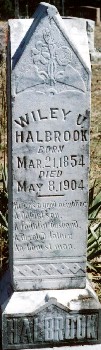
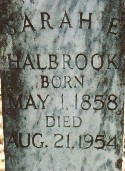
Wiley was buried in the Wolverton Cemetery up on
Wolverton Mountain not far from Clifton Clowers' old home place. His wife,
Sarah, lived another 50 years. She was buried beside him and her vital
statistics were engraved in the side of his tombstone. The stone is located
between them at a forty-five degree angle rather than 'square.' His information
is toward him and her's is toward her. There was a stave bolt mill in the area. It made wood boards for barrel
heads. Blocks of wood were carried to a saw and the sawyer cut the short boards.
The man who carried the blocks couldn't keep up and, periodically, the other
workers had to stop and help him catch up. One of Andrew's relatives was aware
of this and asked the owner if he would pay two men's wages for someone who
could keep up. The owner promised he would. The relative told Andrew that he
would lend him a mule and sled if he would take the job and bring the mule back
for the relative to care for each night. Andrew took the job, and not only kept
an adequate supply of blocks at the saw, but had time to do other jobs around
the mill as well. The owner was very happy to pay $2 a day for such good help
and the relative was happy that he could be of help to Andrew by lending him the
use of the mule.
Hettie's mother married 'Phrony' Newton, but he was hard to get along with.
He wouldn't let her sons, Ed and Elbert visit her. Actually they did get to
visit sometimes, but he wouldn't feed them when they came. Finally she went over
to Andrew and Hettie's and said she was going to leave Phrony, and she wanted
Andrew to go get her things. Andrew (who would have been Phrony's
stepson-in-law) went over there and told Phrony why he came. Phrony said he
didn't know she was leaving. Andrew replied that if he had known Phrony hadn't
known about it, he would have brought her over to tell him herself. Phrony said just to go
ahead and take her stuff anyway.
Clyde and the Colt Baby Rose and the Snake Clyde's First Day at School Crossing the Flooded Creek in a Wagon The Runaway Wagon When Lyonell was born, Clyde was about 15. He was too old to be hanging
around the house during the birth; so, since he had not been allowed to go out
hunting alone with the rifle before, he was given the rifle and told that he
could go hunting. That kept him away until the baby came. Rose was about 12
years old and she probably took care of Opie, who was five. They soon moved closer to town to a place on the east side of Highway 95
north of the gin and west of the school. It was across the road from where Jerry
Roberson lived.
Elbert's Gunshot Wound Elbert's Death Elbert's Bequest Andrew would often be behind the plow at the end of a row
waiting for the sun to come up so he could see how to guide the plow. When he
was working the place down on the creek he would stop at lunch, climb a
particular tree on the bank of the creek overlooking a nice hole of water, and
shoot a fish for lunch. He would take it to Rose's and she would cook it while
he plowed some more. The tree was in an ideal location and leaned over the creek
so that he had a good shot at the fish. However, he started up the tree one day
and his rifle went off accidentally and shot a hole through his hat brim. He
climbed back down, went back to plowing, and never tried to shot a fish from a
tree again.
In the early 1920s, the state started a program of
dipping cattle to reduce the tick problem in the country. Dipping vats were
built in various neighborhoods and the farmers were told that they would have to
have their cattle dipped at no cost. The Arkansas hill people were a pretty
stubborn bunch and they didn�t like being told what they had to do, so some of
the worst bunch blew up some of the vats. The sheriff asked Andrew if he would
like a job guarding a vat in the Lanty area. Andrew asked how much it paid and
the sheriff told him $10/day. That was a time when a typical job paid $1/day.
Andrew said he wouldn�t be a guard for $10/day. The sheriff asked, "What would
you do it for?" and Andrew said, "$20/day." The sheriff said, "Get your things
together. You have the job." The State forced all the farmers to get their cows dipped
to get rid of the terrible tick problem. They were dipping cows in the community
a mile east of the current location of Wonderview School and one of the farmers
said he�d shoot anyone who came into his lot to get his cow. The sheriff told
the men to go on and dip the cattle from the other farmers and then he would
arrest the one who was refusing. When the sheriff called the man out and started
to arrest him, the farmer said, "I�ve decided I�m going to dip my cow."
The post office in north Conway County was originally at
Rhondo, a place about � mile north of Cleveland. There was schoolhouse on the
east side of the road and a store on the west. Mail was dropped through a slot
in the door of the store. A Massey was postmaster there. The farmers and moonshiners in the hills of Conway County
weren�t interested in paying taxes. But when the folks down at the county seat
decided that a bridge was needed across the Arkansas River, a taxing district
was formed and everyone within a twenty-mile radius was taxed to build the
bridge. The farmers out on the northern fringes of the district refused to pay.
The county started foreclosing on the land, but finally realized that they
weren�t going to get anywhere that way and a text amnesty was declared. All the
farmers who paid the current year�s taxes were forgiven their tax debts from
previous years. In the early days of highway building for automobiles,
counties were given responsibility for the roads within their borders.
Apparently the roads weren�t being built and maintained and the counties were
going brook, so the state took over the highways and established a system of
state highways. The counties were still responsible for local
roads. George Rhoads and his family lived in a community on the
bank of the Arkansas River east of the foot of Petit Jean Mountain called Paw
Paw Bend. One of the families had sold a piano to another family and George
Rhoads was providing his wagon and team to haul it. Several men were there to
load the piano and one of them suggested securing it some way to keep it from
shifting. George said it wouldn't be a problem and hurried his team down a bank
to the road. The piano fell over and crushed his head. My mother's father was teaching school about that same time. They lived in a
house near the middle of town. Momma and Lyonell were about five years old, but
he remembers watching her from the barn as she walked from her house and through
the field by the cotton gin to the schoolhouse to meet her father after school.
Her family probably moved on before she started to school and by the time the
consolidated high school was built in the 30s, she had been sent to school in
Morrilton. So they were acquainted when they were young, but didn't really know
each other until she was a widow after the war.
My step-dad, Lyonell, likes to get away from the house sometimes when someone
is there to care for my mother. He usually asks me to drive him a few miles up
the road to the area where much of his early life was spent. As we drove along
one time talking about family, I mentioned to him the odd fact I�d noticed in my
family line. My children never got to see their Grandfather Skipper because he
was killed in WWII when I was small. I didn�t see my Grandfather Skipper because
he died the year before I was born. My father was born after his Grandfather
Skipper died and my Grandfather Skipper was born after his Grandfather Skipper
died. Lyonell seemed to be affected a little by this and he told this story:
Re-posted: 11/12/02 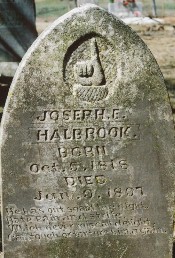 The
Halbrooks migrated to the Wolverton Mountain area of Conway County Arkansas in
1845. William Halbrook, his stepson, John Reynolds; and sons Jerry Halbrook and
Joseph Erwin Halbrook made it to the area of the valley where East Point Remove
Creek begins. William had been born in North Carolina in 1782 so he was 63 at
the time. Joseph Erwin was about 35. John Reynolds was the son of Judith McGee
Reynolds. She was a widow when she married William Halbrook. The story is that
Judith stayed in Memphis because of Indian trouble and didn�t join the men until
later.
The
Halbrooks migrated to the Wolverton Mountain area of Conway County Arkansas in
1845. William Halbrook, his stepson, John Reynolds; and sons Jerry Halbrook and
Joseph Erwin Halbrook made it to the area of the valley where East Point Remove
Creek begins. William had been born in North Carolina in 1782 so he was 63 at
the time. Joseph Erwin was about 35. John Reynolds was the son of Judith McGee
Reynolds. She was a widow when she married William Halbrook. The story is that
Judith stayed in Memphis because of Indian trouble and didn�t join the men until
later.
Joseph Erwin Halbrook was the father of John Reynolds Halbrook
from whom the Halbrooks of this story descended. Another of Joseph�s sons was
Wiley, who is mentioned in a later story. John was born July 8, 1840, so he was
only five when his grandfather William, his father, and his uncles made the trip
into Arkansas. John must have stayed in Memphis with his mother and the other
women and children. Joseph died in 1897 and was buried in
the Halbrook Cemetery at the foot of Wolverton Mountain in northeast Conway
County.
Hate pain and strife.
Which
never miscall delight.
Can touch or torture him again.
Sometime around 1880, John Halbrook and his family
moved to Texas. The move was just before or just after Andrew Jackson Halbrook
was born in 1882. Andrew was just a little boy when they moved back to Arkansas.
What Andrew remembers is based on what his father told him. The group had a goal
of traveling ten miles per day. At a speed of two miles per hour, that would
have meant five hours of travel each day. The rest of the day would have been
spent preparing meals and making and breaking camp. In their travel through one
area they cut down holly trees for the cattle to eat. Even though holly leaves
have sharp points on them, the cattle loved them and came running when they
heard the men cutting down the trees.
The distance from northeast Texas
to northeast Conway County Arkansas is about 200 to 300 miles. At ten miles per
day, it would have taken them nearly a month to make the trip. The trail took
them through DeQueen, Arkansas. Some distant relatives had settled there and
Andrew always wanted to go back and check on them when he grew up, but he never
did. Not long after little Andrew and his family got back to Conway County,
Hettie Rhoades was born. The family told Andrew that he now had a little
girlfriend and he always claimed that she was his girlfriend. I guess they were
boyfriend and girlfriend all her life.
The Newlyweds Win the Informal Cotton Picking Contest
Setting Up Housekeeping
The Halbrooks' New Cabin
A Message in the Night
 One day John Halbrook and his sons Andrew and Allen had
gone to the creek not far from where John's brother Wiley lived to do some
trotline fishing and to camp overnight. The men had set out the trotline, prepared
camp, and had gone to bed for the night. Late in the evening, Wylie's son,
Clarence, made his way along the trail by the creek and up to the camp. He
slipped into his Uncle John's bedroll, crawled up close to him, paused, took a
deep breath, and whispered, "Uncle John! Uncle John, Daddy died!" John said,
"Surely not!" But they knew Clarence couldn't be joking. They broke camp and
went over to Wylie's house to comfort the family and lay out the body. They
never went back for the trotline.
One day John Halbrook and his sons Andrew and Allen had
gone to the creek not far from where John's brother Wiley lived to do some
trotline fishing and to camp overnight. The men had set out the trotline, prepared
camp, and had gone to bed for the night. Late in the evening, Wylie's son,
Clarence, made his way along the trail by the creek and up to the camp. He
slipped into his Uncle John's bedroll, crawled up close to him, paused, took a
deep breath, and whispered, "Uncle John! Uncle John, Daddy died!" John said,
"Surely not!" But they knew Clarence couldn't be joking. They broke camp and
went over to Wylie's house to comfort the family and lay out the body. They
never went back for the trotline.
Andrew Gets A Job
Hettie's Widowed Mother's Short Second Marriage
INCIDENTS WITH THE CHILDREN
Clyde was Andrew and Hettie's first child. He
was born in 1904 and in those days the babies and little children went to the
fields with their parents. Clyde was left on a pallet in the shade at one end of
the rows and the family's little dog stayed with him. On day a young colt was
allowed to follow its mother during the plowing, but it got bored walking up and
down the rows so it started exploring. When Hettie went to check on Clyde, she
found the colt nosing around the pallet with the little dog standing between it
and Clyde to make sure it kept its distance.
A few years later they had Rose. Clyde now
stayed at the pallet to watch Rose while his parents worked in the fields. One
time they came to check on the children and found a large snake near the pallet.
They asked Clyde, "What would you have done if the snake had crawled onto the
pallet with Rose?" and he replied, "I would have dwagged her off!"
The Halbrook�s were
living near the Old Liberty School when Clyde started school around 1910. Andrew
rode the horse and took Clyde to school. He told Clyde that he�d be back to pick
him up at the end of the day. When school was out, Clyde stood and waited on the
trail looking for his father but there was no sign of him. Clyde was getting
worried, but two older boys, Martin Bost and Monroe Scroggins, told him not to
worry they would get him home. Monroe put Clyde on his shoulders and headed
toward the Halbrook�s. They met Andrew just a little way from the school. Clyde had a strong
feeling for Monroe Scroggins from then on.
My step-dad was about 15
years younger than Clyde. In the 1920s they still used wagons and mules around
the farm. (Probably on into the 40s as well.) Andrew owned several hundred acres
down on the creek bottoms where Brock Creek and the west fork of Point Remove
Creek join. Silt from occasional floods made rich farmland but, of course, the
floods sometimes caused problems. When Daddy was about 5 or 6, he and his
father, Andrew, were at the creek in a wagon pulled by mules with a riding horse
tied to the wagon. The horse pulled loose and crossed the creek, which was
flooding and almost too deep for the wagon. They crossed the creek in the wagon
and caught the horse, but on the way back across, the bed of the wagon floated
free of the wagon wheels and frame. Andrew braced his feet against the front of
the wagon bed and held tightly to the lines so that the mules would pull the
floating wagon bed along with the wheels and frame that rolled along the bottom
of the creek. As the wheels rolled into a shallower part of the creekbead, the
frame rose enough for the bed to settle onto it again.
One time Brock Creek flooded and washed a narrow
ditch across the field to the west fork of Point Remove Creek. Weeds had grown
up head-high so the ditch was not visible. Andrew was standing in the front of
the wagon bed to get a better view over the weeds, but didn't see the ditch.
Daddy was in the back of the bed. The ditch was narrow enough for the mules to
step across, but when the front wheels of the wagon dropped into the ditch,
Andrew was thrown onto the rigging behind the mules. That startled the mules and
they began to run. Andrew fell under a front wheel of the wagon but held the
lines as he was dragged along on his belly until he got the mules stopped, thus
saving his little boy from a run-away. Daddy said his father had a 'whelp'
across his back that stood out the size of a man's forearm.
Give That Kid the Rifle and Get Him Out of the House!
At the time,
they lived north of Cleveland on the west side of SH 95 and owned property on
the east side where Mr. Gilkerson used to live. Hettie's mother, Grandma Rhoads,
lived across the lane from the Harmston house. Apparently Grandma Rhoads was
with Hettie during the birth.
The Misfortunes of Hettie's Brother Elbert
When Elbert was a little boy, his older
brother Ed accidently shot him in the leg with a shotgun. The bone was too
shattered to grow back but it wasn't bad enough to be amputated so he limped
along on a limber leg for the rest of his life. Doc Coley helped Hettie get some
silver 'nippers' to use to pick bone splinters out of Elbert's leg.
Hettie cared for her little brother, Elbert, who was
dying of TB, during his last days. He was too weak to raise his head and spit
the material he coughed up into a container. He would just spit over the side
of his cot. They kept newspapers on the floor to keep the spit off the floor. Doc
Coley came to check on him every day, and he always had the latest newspaper
under his arm. He would 'absentmindedly' leave the paper behind when he left.
He knew that they couldn't afford to buy paper to put on the floor.
Elbert was in his 20's when he died. When he died, Andrew took a large plank
from a cattle trough in the barn to 'lay' Elbert 'out' on. Lyonell was sad that
there wasn't anything better for his uncle to be 'laid out' on. 'Avuncular' is
the word for that special relationship of an uncle to his nephews and nieces,
especially for the children of his sister.
Hettie was the family nurse and had nursed Elbert
most of his life. Although he had a wife, Elbert made his insurance policy out
to his sister, Hettie. They used the proceeds of the insurance to bury him and
had about $300 left over. Hettie offered it to Elbert's wife but she said for
Hettie to kept it for taking care of Elbert. But the relationship between
Elbert's wife and Hettie was a little strained after that. Elbert's wife got his
new Model-T.
Shooting Fish for Dinner
ANDREW GUARDS THE DIPPING VAT
Andrew cleaned up his Winchester and a
pistol and took a cot to the dipping vat. Eb King lived near the dipping vat and
he didn�t like the vat or the fact that a guard was there. He was in V. H.
Merrick�s Lanty store and told V. H. that he was going to go over to the dipping
vat and "beat that young fellow like a dog." V. H. said, "Eb, don't you owe a
little balance here at the store? I�d sure appreciate it if you would pay that
off before you go!" Eb said, "Don�t worry about me. I�ll beat him like a
dog!"
Eb headed down toward the dipping vat about dark and Andrew heard
him coming. When Eb got within earshot, Andrew levered a shell into his
Winchester. Eb stopped and called out, "Hey, careful! I'm just coming over to
talk for awhile." Andrew said, "Who are you?" Eb told him and Andrew said,
"Well, come on over like a man and we�ll talk."
Andrew made Eb sit on the
cot beside him, but it turned out Eb didn�t have much to say and soon left.
A Farmer Decides To Have His Cow Dipped
WORKING FOR THE U.S. POSTAL SERVICE
Parker Riddling
was postmaster when the office was moved to Cleveland. Ludy Carlisle was
postmistress in a building on the east side of the road. Parker was the
postmaster in the old store on the west side of the road through F. D. R.�s
presidential term.
In the early days of the post office in Cleveland,
mail was exchanged with the post office in Solgohachia which in turn exchanged
mail with the post office in Morrilton, the county seat. Postmasters operated
the post offices as government appointees, but the mailed was carried from post
office to post office by contract mail carriers. Men interested in the job had
to be bonded and bid for the job. They had to provide their own transportation.
Mathew Pack had some money and won the bid to carry mail between Cleveland and
Solgohachia. Andrew bought Mr. Pack�s two-horse mail hack and the contract.
Andrew would sometimes let his son, Clyde, carry the mail.
The mail was
supposed to leave Cleveland at 8:00 a.m. That allowed time to reach Solgohachia
at noon to meet the carrier from Morrilton. After the mail exchange, the return
trip could be made by 4:00 p.m. During cold weather, a stone warmed in the
fireplace and wrapped in a blanket and was placed in the hack to provide heat
during the trip. The stone was reheated at Solgohachia for the return
trip.
Later in the �20s, Andrew bought a Model-T Ford. The bridge across
East Point Remove Creek was probably in place by then. Andrew could now make the
10-mile trip in less than an hour. He could exchange the mail at noon and be
back to Cleveland by 1:00. This pleased the Cleveland postmaster and left Andrew
time to do other work around home. Andrew asked to be allowed to wait until
10:00 a.m. to leave with the mail since that would give him plenty of time to
get to Solgohachia to meet the Morrilton mail and allow him more time at home to
get work done there. The postmaster finally agreed to letting Andrew leave later
just to insure that Andrew would use his car and be back by 1:00. He said he
couldn�t change the official start time, but he wouldn�t report Andrew if he
left at a later time.
PAYING FOR THE ARKANSAS RIVER BRIDGE AT MORRILTON
When Lyonell was about 6 or 7 years old, the river
flooded and almost washed the bridge away. Someone took him to see the flood and
they saw animals and houses floating by. A rumor went through the crowd that a
certain had been caught down in his bottomlands and was trapped in a tree.
Someone else said not to worry about him because he knew the river and could
cross it even in flood. He said to expect him on this side of the river at the
end of the day. The man did show up later in the day. He knew to paddle upriver
along the edge where the current was slow and then paddle across as the flood
swept him downstream to where he wanted to get out.
WORKING ON STATE HIGHWAY 95
Local residents contracted to bring the existing roads up to state
standards and to build new road. Andrew had a contract to work on Highway 95 in
the Cleveland area. Lyonell was old enough then to be of some help. Horses were
used to power the equipment. One of the dirt moving devices was like a big scoop
with wheelbarrow handles. A team was connected to attachments on each side of
the scoop back toward the midpoint. The operator would lift the handles to dip
the front edge of the scoop into the dirt as the team pulled forward. By
controlling the scoop angle, the operator could scoop out a quantity of dirt.
The team then pulled the scoop to an area to be dumped. Lyonell was old enough
at 9 or 10 years old to guide the team and the scoop to the dumpsite where an
adult would dump it. Lyonell would then drive the empty scoop back for another
load. There were other scoops in this filling and emptying cycle to that the
strong workers were kept busy filling and dumping the dirt while the younger
ones shuttled the scoops back and forth.
Death of George Rhoads
George, Jim, and
Ed Rhoads were Hettie's brothers. Ed was also living in Paw Paw Bend when George
was killed and he decided to move back to Cleveland. Some of their goods may
have been moved by truck, but Ed also moved some by wagon. Ed and Hettie's son
Clyde (about 24) were making a trip from Cleveland back to Paw-paw Bend to haul
another load. Lyonell was about 8 years old and he got to go with them. It was
about a 10-hour trip by wagon. They left at sundown and arrived about sunup.
Lyonell rode on a quilt in the wagon bed, but since only the seat had springs,
the ride was pretty rough. He did sleep some and woke during the night to see a
large bird fly past the moon.
Lyonell and Louise as Children
Bringing Grandpa to the Fish Fry
Andrew, the subject of most of these stories, was Lyonell�s father and John
Reynolds Halbrook was Andrew�s father. Andrew didn�t do much fishing because of
all the farm work he had to do, so when he did go, he took all the family along
to have a big outing. Lyonell recalled a fishing trip they took around 1925 when
he was about five years old and his Grandfather Halbrook was about 85. They
loaded all the gear they needed for cooking and camping into a wagon and
traveled the three miles from Cleveland to a small creek that ran between the
Liberty Cemetery and John Halbrook�s home. Andrew's brother, Will, and several
others had wagons there. Some of the men cut down a tree, hooked their horses to
it, and dragged it through a �hole� upstream to muddy the water and make the
fish come to the surface. They got so many fish, including a very large trout
(or bass) that they decided to bring Grandpa down to join in the fish fry.
Andrew had also brought the T-Model that he used for carrying the mail.
Andrew's brother, Allen, offered to drive it to get Grandpa and they agreed that
Lyonell could ride along. When his Grandpa got into the single bench seat,
Lyonell crawled over the back of the seat and rode in the homemade mailbox. He
leaned over the seatback to be between the men so that he could listen in on
their conversation.
Lyonell said that when they got to the camp and his
Grandpa saw the many big fish, his grandpa�s eyes just �danced� and �flashed.�
He said that Grandpa�s eyes always did that when he was pleased and excited.
Lyonell's Granpa Halbrook died within a year or so of that time.
I think
Lyonell�s eyes �danced� a little, too, at the memory of that long-ago event.
PAGE
ONE
PAGE
TWO
PAGE
THREE
SITE INDEX
Moved to Hostinger in July 2026